
 © Paul Glaser
Promote what is good for Görlitz.
Education: School and daycare
Good education begins at home. We have invested heavily in recent years – and we will continue to do so.
Balance sheet:
- New daycare center “Südstadtkinder”
- Renovation of the daycare center on Cottbuser Straße
- Renovation of Königshufen Elementary School
- Renovation of the special education center “Mira Lobe”
- New construction of the city center high school (under construction)
- Agreed priority list with the school principals
Goals 2026–2033:
- Continue sustainable and future-proof school and daycare renovations consistently
- Development and opening of the 5th secondary school as a modern cluster school
- Renovation of the high school in the city center and the two Melanchthon schools
- Curie Gymnasium expansion planned
- modern specialist rooms and digital equipment
- Close cooperation with the university and TU Dresden:
› Practical experience for teacher trainees in Görlitz
› Recruiting new teachers for our schools
Family, Social Affairs and Health
Family-friendliness is at the heart of our city policy. Families of all generations are our focus.
Balance sheet:
- Strengthening the family office as a central point of contact
- Expansion of childcare and good coverage rates in daycare centers
We know:
Ensuring medical care and nursing services is of particular importance.
Goals:
- Further recruitment of skilled workers with the East Saxony physicians' network
- "Welcome package" for doctors, teachers and other professionals
- Expansion of care services and short-term care
- A renewed "social conference" based on the 2009 conference, to re-examine child poverty and social issues
- Establishing a municipal prevention chain in the social sector – Görlitz as a pioneer in Saxony
- the socio-cultural center in Plant I will be preserved
Citizen communication and participation
Görlitz thrives on engaged citizens. We have created structures that facilitate participation.
Balance sheet:
Citizens' councils and annual citizens' assemblies in eight participation spaces:
- King's hides
- Klingewalde/Nikolaivorstadt
- Weinhübel
- Biesnitz
- City Center East
- City Center West
- South City
- Rauschwalde
We are a role model for other cities.
Project-related citizen participation, e.g.:
- ERDF project “Gründerzeit city center”
- Brautwiesenplatz: Workshops from the initial idea to completion
- additional town hall meetings with the mayor, deputy mayors and city officials
Citizen dialogue on key issues:
- 2021 Overall Transport Concept
- 2022 Tree Protection Ordinance
- 2023 Public Transport Model City
- 2024 City Hall
- 2025 Development of Lake Berzdorf
Goals:
- Further strengthen and bindingly integrate citizens' councils
- combining digital and analog participation
- Further expand the platform zukunft-goerlitz.de and other online services
- Continue the youth fund and support the youth council
Digital Administration
A modern city needs a modern administration.
The consistent digitalization of the administration, in order to improve service and citizen-friendliness, is central to our approach.
Balance sheet:
- Visitor management introduced in government offices
- Digital council information system “More Rubin” for draft resolutions and decisions in committees and the city council
- Fiber optic rollout nationwide by the end of 2027
Goals:
- Digital-first strategy for internal processes and administrative tasks
- Development of a citizen portal with secure online services
- Online payment platform for municipal services
- Further digital procedures for construction, trade, registration law
- Digitalization as a growth driver
- Strengthening digital resilience
This also includes the town hall itself: In order to master future demanding tasks such as the digitalization of the administration, a high-performing and motivated team is needed, which is specifically supported.
For this reason:
- Flexible work arrangements (e.g., home office, family-friendly working hours)
- Training initiative for digital skills
Sport, volunteering, clubs and social cohesion
Volunteering and clubs represent a vibrant Görlitz.
Balance sheet:
- Volunteer platforms and volunteer card
- Strengthening the interests of allotment gardeners through the establishment of an allotment garden advisory board
- Establishing the Rabryka through offerings for all generations
- New fire station on Cottbuser Straße (City Center Fire Station)
- Sports investments: Hirschwinkel sports complex, Cottbuser Straße sports hall (renovation)
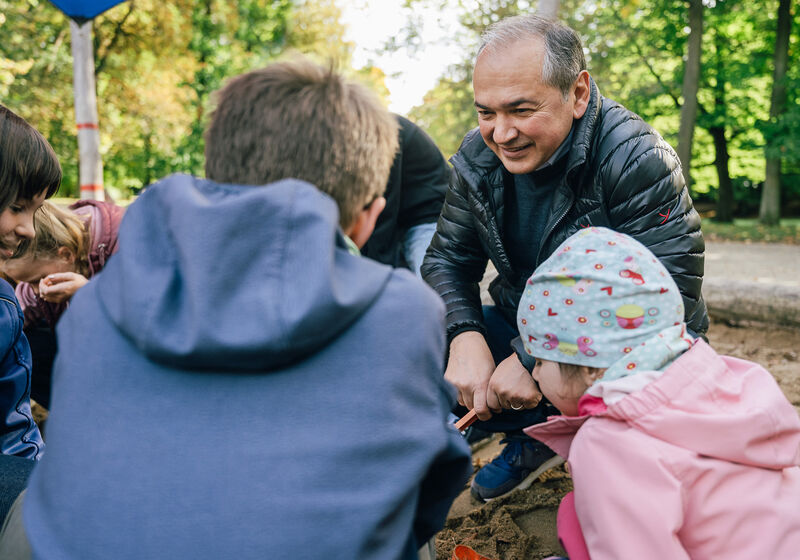
- new playgrounds in the city park and Brautwiesenpark
With regard to sports infrastructure, we agree that a new football stadium is needed in Görlitz in the long term. This is a goal we will work towards together in the coming years.
Goals:
- Long-term planning for a new, city-compatible football stadium
- Modernization and expansion of the Neisse Bath
- Renewal of the roof and modernization of the Jahn sports hall
- Renovation of the Biesnitz sports field for school and club sports
- Support in building a new animal shelter
- Better conditions for volunteers (advice, premises, technology)
Art, culture and European city
Görlitz/Zgorzelec is a European city – that shapes us.
Balance sheet:
- Opening of the Görlitz Synagogue Cultural Forum and installation of the Star of David
- Numerous commemorative and cultural events, honorary citizenship for Shlomo Graber
- Founding of Lausitz Festival GmbH – Görlitz as a festival city
- The theatre, museums and many independent organizations play a strong role
- Brückenpark I and II as a joint urban development project on the Neisse River
- Cultural Development Planning
- Establishment of galleries and art venues
Goal:
Deepened binational cooperation with our partner city Zgorzelec.
Specifically:
- Expansion of the freight depot as an interim location and renovation of the theatre's stage house
- cultural institutions and events, especially the theatre with all its genres and the ViaThea, are preserved
- Strengthening the film city of Görlitz
- Supporting the development of a cultural network
- joint cultural and youth projects
- European conference in the town hall with a focus on Central and Eastern Europe
- coordinated urban development on both sides of the Neisse river - for example via the Interreg project "Brückenpark II"